

Smarter Ways to Spend Your Budget
Why Paid Ads Feel Like a Gamble
Garden center Google and social ads often feel like a gamble because the money goes out quickly, but the results are inconsistent or unclear. One campaign might bring in traffic, the next barely moves the needle, and it is rarely obvious why.
This frustration shows up in different ways. You run a spring campaign, see some clicks, maybe a bit of engagement, but you cannot confidently say what actually drove revenue. It leaves you questioning whether ads are worth it at all.
The real issue is not the platforms. It is how ads are typically set up. Many campaigns are run in isolation, without strong supporting content or a clear landing experience. That disconnect is where most of the waste happens.
This post will walk through how to tighten your approach so your ads feel less like a risk and more like a system. You will also see how Salisbury Greenhouse turned a simple spring gift card campaign into measurable results.

Where Garden Centers Typically Waste Ad Budget
Most wasted ad spend does not come from one big mistake. It builds from a series of small gaps.
Sending traffic to the homepage is one of the biggest ones. It feels like a safe default, but it rarely works. A homepage tries to do too many things at once. When someone clicks an ad about a specific promotion, they should land somewhere that continues that exact message.
Boosting posts without a clear objective is another common issue. A nice visual gets attention, so it gets promoted. But without a defined goal, engagement stays surface level. It does not translate into sales or store visits.
A lot of campaigns also run without proper tracking. This is where things really start to fall apart. You might see clicks or impressions, but you do not know if those clicks turned into purchases or signups.
Audience targeting is often too broad. Ads end up reaching people outside your core market, which drives up costs without improving results.
Then there are seasonal campaigns that lack urgency. Spring is busy, but if your offer is not clear or time-sensitive, people will scroll past and come back later. Or not at all.
None of these are random problems. They are structural. Once you see them clearly, they become fixable.
How Social Ads Actually Work (When Done Right)
Social ads are not driven by intent. They are driven by attention.
When someone searches on Google, they are already looking for something. On social platforms, they are not. Your ad has to stop them mid-scroll and give them a reason to care.
That is why creative and messaging matter more than budget. A strong visual paired with a clear, timely message will outperform a higher spend campaign that feels generic.
This is especially important in garden center marketing. You are working with one of the most visual industries out there. Color, texture, and seasonal inspiration should do a lot of the heavy lifting.
Context also matters. A spring promotion should feel like spring. That means fresh imagery, timely messaging, and a clear connection to what customers are already thinking about.
When ads underperform, it is rarely because the platform failed. It is because the setup around the ad was not strong enough to carry it. If you are investing in ads, the content behind them matters just as much as the campaign itself. Strong landing pages and blog content help turn clicks into actual customers. If you want to see how educational content supports this, this guide on garden center blog content breaks it down in a practical way
The Missing Link — Content + Landing Pages
This is where performance shifts from inconsistent to predictable.
A strong campaign follows a simple path:
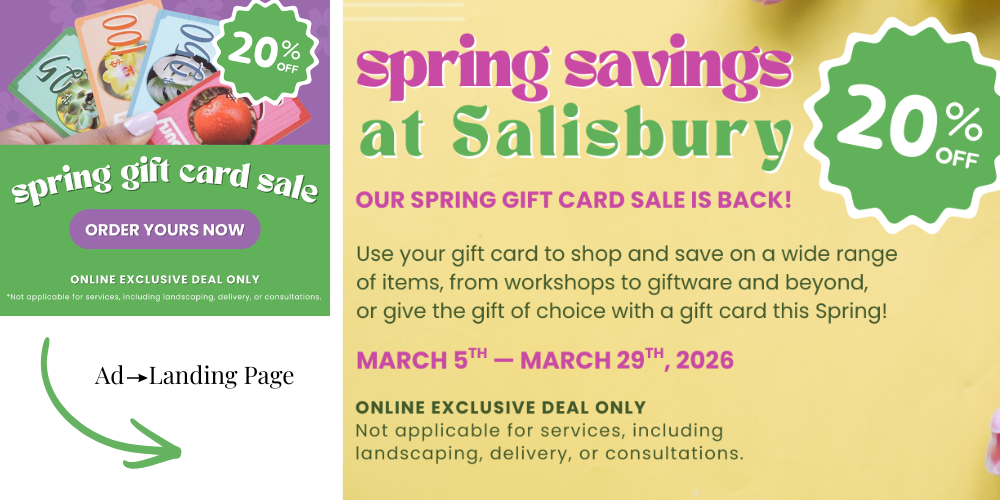
Ad → landing page → clear action
When someone clicks your ad, they expect continuity. If the ad promotes a spring gift card offer, the landing page should immediately reinforce that message.
Focused landing pages consistently outperform general pages because they remove distractions and guide the visitor toward one outcome.
Strong landing pages include:
- A headline that directly matches the ad
- One clear call to action
- Visuals that support the offer
- Seasonal relevance
- Minimal navigation
This is where most campaigns break down. Ads are often treated as standalone efforts, when they should be part of a connected system.
When social ads and landing pages are aligned, results become easier to measure and improve. Instead of hoping the campaign works, you start building something repeatable.
Tracking What Actually Matters
Without tracking, you are relying on assumptions.
Clicks can look promising, but they do not tell you if the campaign actually worked. You need to focus on outcomes.
For garden centers, that usually means:
- Purchases
- Gift card sales
- Event signups
- Email subscriptions
Cost per result gives you clarity on efficiency. It tells you how much you are paying for each conversion.
Return on ad spend shows the bigger picture. It connects your ad spend directly to revenue.
The key is setting this up before your campaign launches. Once everything is tracked properly, decisions become much easier. You are no longer guessing. You are responding to real data.
Case Study — What Worked for Salisbury Greenhouse
This is where everything comes together.
Campaign Overview
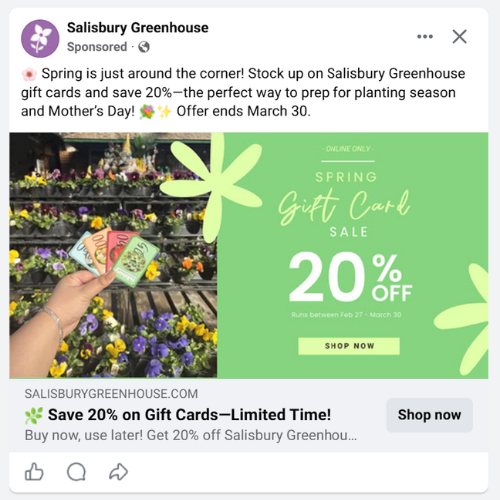
Salisbury Greenhouse ran a spring gift card campaign from early to late March with the goal of driving early-season revenue and encouraging store visits.
What They Did Well
The offer was simple and timely. Gift cards tied directly into the upcoming gardening season, making them easy for customers to understand and act on.
The messaging aligned with spring momentum. Customers were already thinking about planting and outdoor projects, so the campaign felt relevant.
The ads stayed focused on one clear promotion, which helped eliminate confusion.
Where Strategy Made the Difference
What made this campaign stand out was not just the ads. It was the structure behind them.
The targeting was intentional. Instead of casting a wide net, the campaign focused on audiences most likely to purchase, which helped keep costs low and relevance high.
The strategy was built around a clear customer journey. Each step had a purpose, from grabbing attention with seasonal creative to guiding users toward a focused purchase experience.
Traffic was directed to a dedicated landing experience rather than a general page. This kept the message consistent and removed unnecessary distractions.
The messaging stayed aligned from the ad through to the purchase point. There was no disconnect or need for the customer to figure things out.
The Role of Tracking
Tracking played a critical role in the campaign’s success.
Conversions were set up and monitored from the start, allowing the team to see exactly what was working. Instead of relying on clicks or engagement, they could measure real outcomes like purchases and revenue.
This made it possible to adjust performance during the campaign, not after it ended. Budget and delivery could be optimized based on actual results, not assumptions.
Performance Results
The results from this campaign were strong and very clear.
The campaign generated the following from a $1,800 media buy budget:
- 437 purchases
- $62,000+ in total sales
- $4.26 cost per purchase
- 33.56 return on ad spend
You can also see steady daily purchases throughout the campaign, with a noticeable spike toward the end of the month. This suggests that consistent messaging combined with seasonal timing helped build momentum.
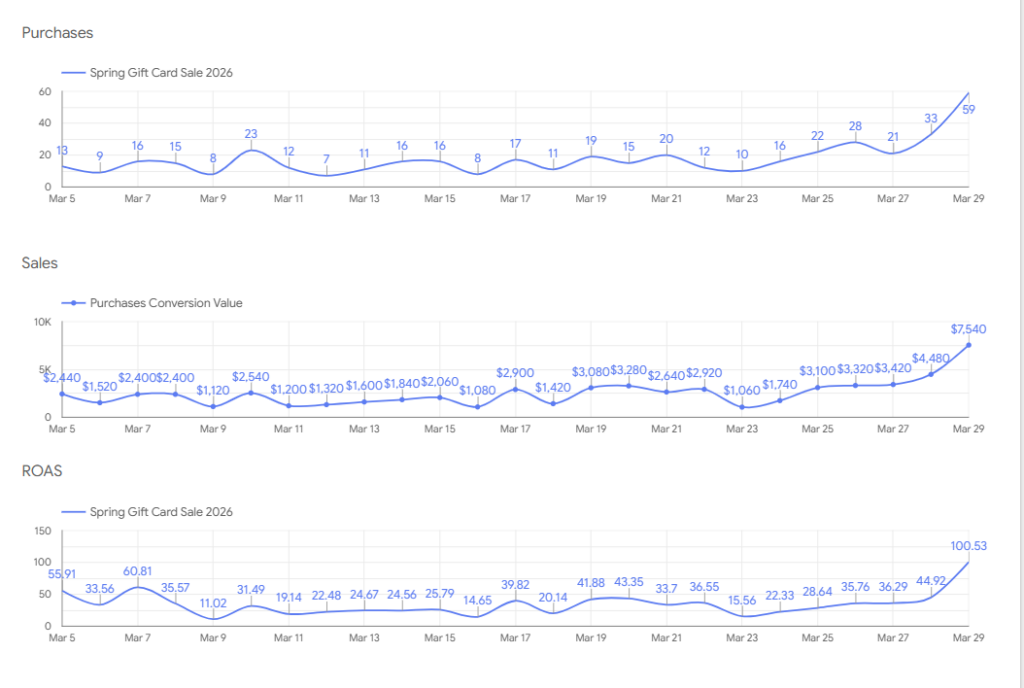
The chart also shows daily revenue climbing as high as $7,540 in a single day, reinforcing that the campaign was not just driving traffic, but actual purchases.
Key Takeaway
This level of performance did not come from ads alone.
It came from a combination of clear strategy, focused targeting, consistent messaging, and proper tracking. When all of these pieces worked together, the campaign delivered results that were both measurable and repeatable.
A Simple Framework to Reduce Waste
If you want to improve your ad performance, keep it simple and structured.
- Start with a clear offer
Make it seasonal and specific - Build a landing page around that offer
Keep it focused and easy to act on - Create ads that match the message exactly
Consistency builds trust - Set up tracking before launching
Know what success looks like - Monitor and adjust based on results
Let performance guide your decisions
Quick checklist:
- Clear offer
- Matching landing page
- One primary action
- Tracking in place
- Regular review and optimization
This approach removes guesswork and replaces it with a repeatable system.
A strong paid strategy works even better when it’s supported by how easily customers can find you in the first place. If your visibility in search is inconsistent, this guide on local SEO for garden centers explains how to improve your chances of showing up when nearby customers are ready to visit
Smarter Ads, Not Bigger Budgets
If you are running ads but not seeing the return you expect, the issue is rarely the platform. It is how everything connects.
That is where we can help. From building a clear campaign strategy and targeting the right audience, to creating landing pages and setting up proper tracking, we focus on making sure every piece works together.
If you want to run a campaign that actually drives measurable results, reach out and we can walk through what that could look like for your garden center.